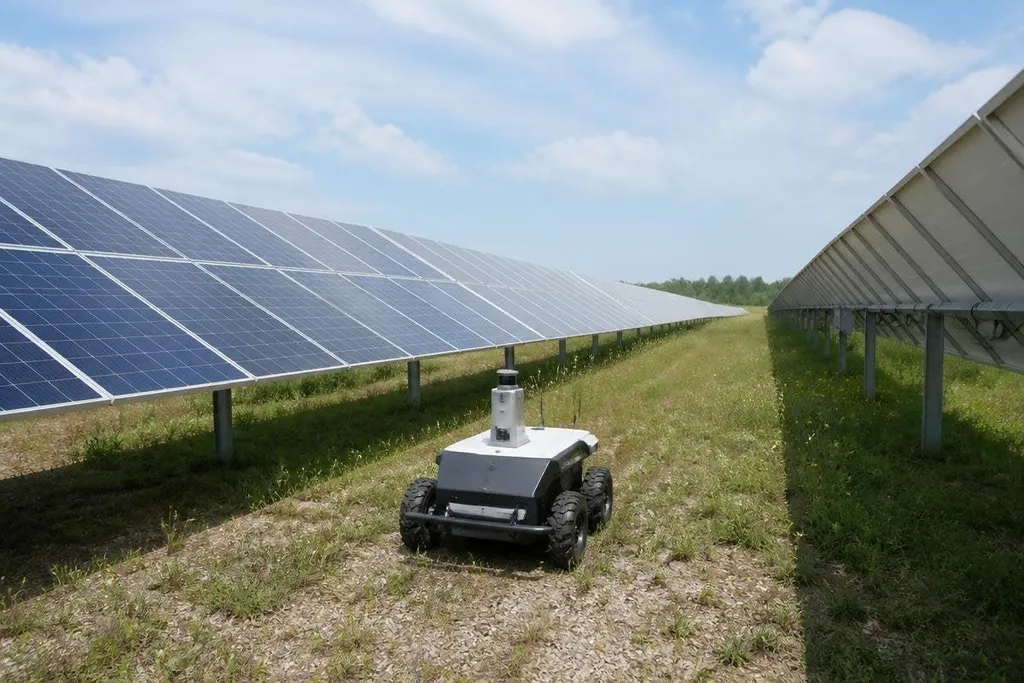
Solar farms stretch across large areas, and much of their output depends on small faults being found early. Robots can move between panel rows, inspect equipment, remove some plant growth, and send maintenance teams to the places that need them.
The useful change is simple: routine work can happen more often without sending people across the whole site.
- Cameras and thermal sensors can check panels for visible damage or hot spots.
- LiDAR helps a robot map rows, gaps, posts, and other obstacles.
- Cleaning and inspection robots still need site rules, safe routes, and human checks.
Where robots do the work
A solar farm robot usually follows planned routes beside or between panels. Some machines inspect the panel surface, while others move close to the ground to check cables, mounts, drainage, or weeds.
The task depends on the robot’s sensors. A camera can record cracked glass, dirt, loose parts, or shading from plant growth. A thermal camera reads heat across the panel surface, which can point to an electrical fault that a normal image may miss.
LiDAR, short for light detection and ranging, measures distance with laser pulses. On a solar site, that data can help the robot keep a safe distance from panel frames and find its way around uneven ground.
The robot does not need to repair every fault. Its useful job may be to mark a panel row, save an image, and send the finding to the maintenance team. That gives a technician a place to start instead of a long list of rows to check by hand.
Cleaning, weeds, and panel output
Dust, leaves, bird droppings, and plant growth can block sunlight from reaching photovoltaic cells. The effect depends on the site, weather, panel angle, and the size of the covered area, so a cleaning robot needs local records rather than a fixed schedule.
A robot can follow the panel layout and clean without driving over the modules. That matters because panels can crack under the wrong pressure, and water use may be limited in dry regions.
A machine that brushes too hard or carries dirt from one row to another creates more work.
Weed control has a similar limit. A ground robot can cut or remove growth near access paths and panel rows, but it must avoid cables, drainage channels, wildlife, and workers. A farm operator still needs a plan for areas the robot cannot reach.
The data matters as much as the wheels
Inspection only helps when the results fit the farm’s maintenance system. The robot needs to link each image or heat reading to a panel row, equipment label, or map position. Staff then need a clear way to review the finding and decide what happens next.
This is where robotics connects with automation software, work orders, and site records. A flagged panel may need a closer inspection. A blocked route may need ground work. A repeat fault may point to a problem with an inverter, cable run, or mounting system.
A flagged panel matters only after the site team knows where it is, when it was checked, and what action followed. Solar farm robotics reporting from Robot24.com can tie that inspection result to the robot, panel row, test date, and repair record before a route change sends the machine back to a known point.
The machine also needs a safe response when its route changes. Rain can soften the ground, vegetation can block a path, and a worker or vehicle can enter the robot’s area. A remote operator may need to stop the mission and send the robot back to a known point.
What solar farm operators should check
Before buying or leasing a robot, use this short decision guide:
- Map the site: record slopes, row spacing, loose ground, gates, fences, and access roads.
- Name the task: choose inspection, cleaning, weed control, or a mix only when one machine can support those jobs.
- Check the records: confirm that images and sensor readings can link to panel rows and maintenance tickets.
- Set safety rules: define stop zones, remote control access, worker alerts, and recovery steps.
- Measure the result: compare missed faults, travel time, water use, or maintenance hours before and after deployment.
These checks also expose a common mistake: buying a robot for a large site before testing its route on the actual ground. A machine may work beside clean rows and fail near a slope, a gate, or a damaged section of fencing.
I’d judge a solar robot by the faults it helps a team fix, not by the number of tasks listed in its brochure.
The next useful step is a small site trial with a defined route, a named maintenance owner, and a record of every missed panel, blocked path, and false alarm.